ESP32-BLE-Sync
Direkte, gekoppelte Bluetooth-LE-Verbindung zum ESP32. Versioniertes Protokoll mit bestätigten Befehlen: Die App zeigt immer den echten Zustand.
ESP32 · Bluetooth LE · iPhone
SpoolDry verbindet deinen Filamenttrockner per Bluetooth mit dem iPhone. Temperatur und Feuchte live, Trocknung mit Profilen für technische Kunststoffe starten, Timer auf dem Sperrbildschirm. Kein Konto. Keine Cloud.
Kein Abo. Einmalkauf. · Bald im App Store

Direkte, gekoppelte Bluetooth-LE-Verbindung zum ESP32. Versioniertes Protokoll mit bestätigten Befehlen: Die App zeigt immer den echten Zustand.
Von PLA bis PEEK, PA-CF und PPS: typische Startwerte mit Herstellerquellen, nie als offizielle Vorgabe dargestellt.
Sperrbildschirm und Dynamic Island zeigen Filament, Ziel, aktuelle Temperatur, Feuchte und Restzeit direkt vom Gerät.
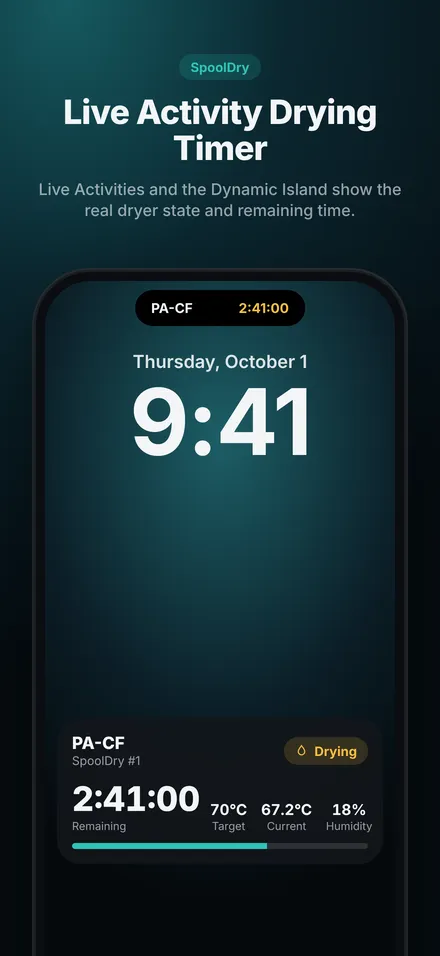
Kein Konto, kein Server, kein Internet. Alles bleibt zwischen iPhone und Trockner.
Sensirion-SHT40-Genauigkeit mit Live-Diagrammen.
Eingebaute Richtwerte plus eigene Markenprofile.
Start-/Endfeuchte, Durchschnittstemperatur, Diagramme und Statistiken.
Firmware-Grenzen, Watchdog, Lüfter-Tacho, Relais, Thermostat und Thermosicherung.
Benenne SpoolDry #1, #2 und mehr und wechsle zwischen ihnen.
Einmal zahlen. Alle künftigen Verbesserungen inklusive.
Trockner bauen oder Firmware auf den ESP32-C6 flashen.
In Sekunden per Bluetooth mit SpoolDry koppeln.
Filamentprofil wählen, Trocknung starten und auf dem Sperrbildschirm verfolgen.
Eine Niederspannungs-Architektur (24 V DC): Netzspannung bleibt im zertifizierten, geschlossenen Netzteil. Die Kammer ist durch den Lüfter auf 70 °C begrenzt; unabhängige Hardware schützt vor Softwarefehlern.
| Bauteil | Gewähltes Teil | Zweck | Anz. | Beispiel-Links |
|---|---|---|---|---|
| ESP32 | Espressif ESP32-C6-DevKitC-1-N8 | Steuerung: BLE, Sensoren, Regelung und die gesamte Firmware-Sicherheitslogik. | 1 | DigiKey · Adafruit |
| Temperature/humidity sensor | Sensirion SHT40 breakout (Adafruit #4885) | Misst Kammertemperatur und relative Feuchte. | 1 | Adafruit · DigiKey |
| PTC heater | Insulated PTC air heater 24 V / 100 W | Erwärmt die Luft, die der Lüfter durch die Kammer bläst. | 1 | Amazon (Bestol 24V 100W) · VXB |
| Fan | San Ace 80 9GA0824P4G001 (24 V, tach) | Bewegt Luft durch die PTC-Heizung und um die Spulen; führt feuchte Luft ab. | 1 | Sanyo Denki · Mouser (9GA0824P4 series) |
| MOSFET | Infineon IRLB8721PBF logic-level N-MOSFET | Low-Side-Schalter für Heizungs-PWM (Q1), Lüfter (Q2) und Relaisspule (Q3). | 3 | Adafruit #355 · Mouser |
| Safety relay | Omron G5LE-1A4 DC24 relay (K1) | Zweiter, unabhängiger Heizungsschalter in Reihe zum MOSFET. | 1 | DigiKey · Omron datasheet |
| Thermostat 85 °C | Cantherm F20A08505ACFA06E thermostat (TS1) | Unabhängiger Hardware-Übertemperaturschutz der Kammer. | 1 | DigiKey · Cantherm F20 series |
| Thermal fuse 100 °C | Cantherm SDF-DF100S thermal cutoff (TCO) | Letzte, nicht rücksetzbare Sicherung im Heizstromkreis. | 1 | DigiKey |
| Heater NTC | Semitec 104GT-2 NTC thermistor + 47 kΩ 1 % resistor | Misst die Temperatur am Heizungsauslass für Leistungsreduktion und Fehlererkennung. | 1 | Mouser |
| Power supply | Mean Well GST220A24-R7B desktop adapter | Versorgt alles mit 24 V DC. Netzspannung bleibt komplett im zertifizierten Netzteil. | 1 | Mouser · Newark |
| Power connector | Kycon KPJX-PM-4S panel jack (mates with R7B plug) | Verriegelnder 24-V-Eingang am Steuergehäuse. | 1 | DigiKey · Kycon datasheet |
| Fuse | ATO blade fuse 7.5 A + Littelfuse inline holder | Schützt die Verdrahtung vor Kurzschlüssen. | 1 | Littelfuse 0FHA0002XP (Amazon) · Keystone 3557-2 PCB holder |
| 5 V regulator | Pololu D24V10F5 step-down regulator | Versorgt den 5-V-Pin des ESP32 aus 24 V. | 1 | Pololu |
| Wires, terminals, passives | Small parts | Aufbau, Steckverbinder und passive Bauteile. | 1 | Adafruit Perma-Proto (Pololu) · Phoenix 1935161 (DigiKey) |
| Enclosure | Hammond 1591XXDSBK ABS enclosure + insulated dry box | Hält die Elektronik kühl und getrennt von der beheizten Kammer. | 1 | Hammond 1591XX |
Links sind Beispiele, geprüft im Oktober 2026; die Verfügbarkeit ändert sich. Gleichwertige Teile mit denselben Werten funktionieren.
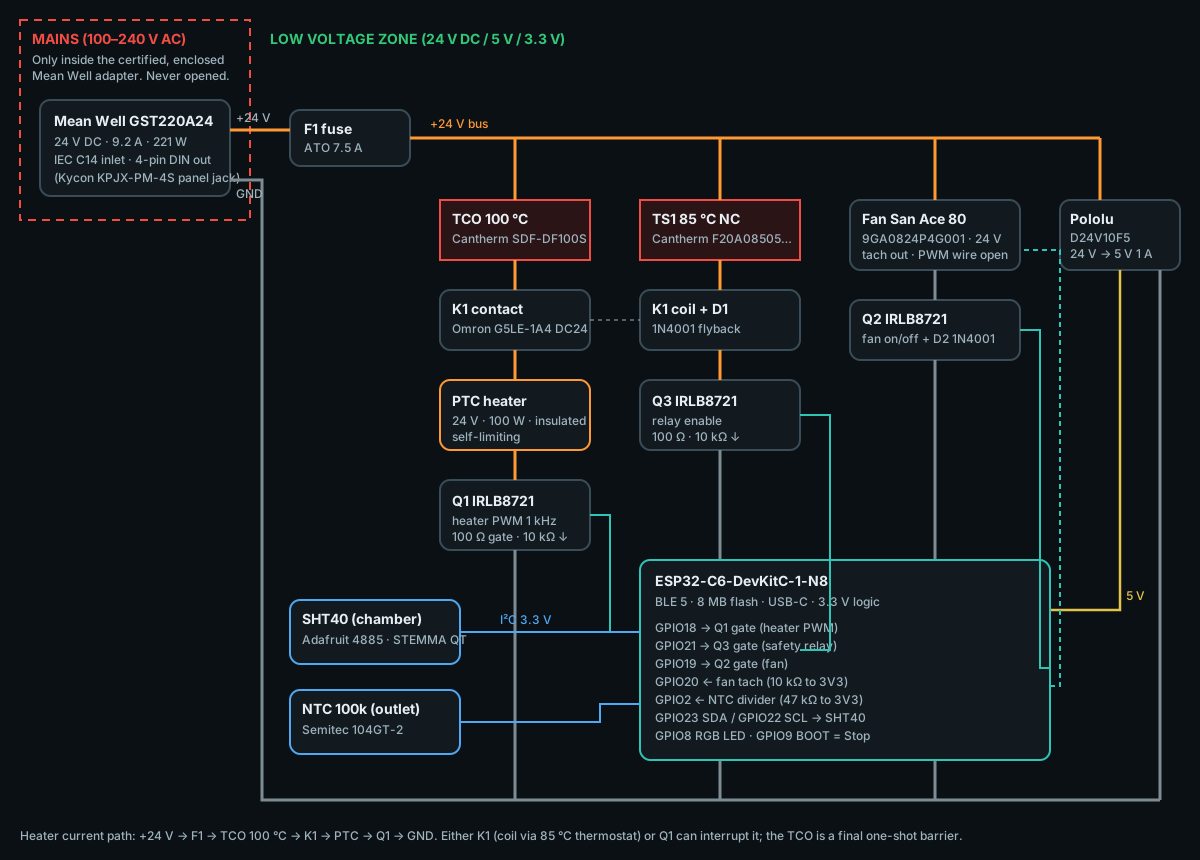
| GPIO | Function | Component | Dir | Notes |
|---|---|---|---|---|
GPIO23 | I²C SDA | SHT40 | I/O | Arduino default SDA on ESP32-C6 |
GPIO22 | I²C SCL | SHT40 | Out | 100 kHz, 25 ms timeout, bus recovery |
GPIO18 | Heater PWM | Q1 gate (100 Ω, 10 kΩ pull-down) | Out | LEDC 1 kHz, 10-bit, soft-start |
GPIO21 | Heater enable | Q3 gate → relay K1 coil | Out | HIGH only while PREHEATING/DRYING |
GPIO19 | Fan enable | Q2 gate (100 Ω, 10 kΩ pull-down) | Out | Forced ON whenever heating |
GPIO20 | Fan tach | San Ace pulse sensor | In | 10 kΩ pull-up to 3V3, 2 pulses/rev |
GPIO2 | Heater NTC (ADC1_CH2) | 104GT-2 + 47 kΩ to 3V3 | In | 12 dB attenuation, 8-sample average |
GPIO8 | Status LED | On-board RGB LED | Out | Strapping pin; LED only |
GPIO9 | Local button | On-board BOOT button | In | Short: stop · 3 s: reset fault · 10 s: clear bonds |
5V / GND | Power | Pololu D24V10F5 output | — | Do not also power from USB while on 24 V without care |
ESP32-C6-DevKitC-1-N8 · USB-C data cable · SHT40 + STEMMA QT cable
(full dryer: see the Bill of Materials above)# Arduino IDE 2.x: https://www.arduino.cc/en/software
# or PlatformIO Core:
python3 -m pip install -U platformio# Arduino IDE → Settings → Additional boards manager URLs:
https://espressif.github.io/arduino-esp32/package_esp32_index.json
# Boards Manager → install "esp32 by Espressif Systems" ≥ 3.3.12
# arduino-cli
arduino-cli core update-index --additional-urls https://espressif.github.io/arduino-esp32/package_esp32_index.json
arduino-cli core install esp32:esp32# Use the USB-C port labelled "UART" on the DevKitC-1.
# Unplug the 24 V supply while flashing from your computer.# Arduino IDE: Tools → Board → esp32 → "ESP32C6 Dev Module"
# Flash Size: 8MB · Partition Scheme: Custom (uses SpoolDry/partitions.csv)
# PlatformIO: board = esp32-c6-devkitc-1 (already in platformio.ini)# macOS: /dev/cu.usbserial-* · Linux: /dev/ttyUSB0 · Windows: COM3
arduino-cli board list# Library Manager → "NimBLE-Arduino" by h2zero ≥ 2.5.1
arduino-cli lib install "NimBLE-Arduino@2.5.1"
# PlatformIO installs it automatically (lib_deps)cd esp32
pio run
# or
arduino-cli compile --fqbn esp32:esp32:esp32c6:FlashSize=8M,PartitionScheme=custom SpoolDrypio run -t upload
# or
arduino-cli upload -p /dev/ttyUSB0 --fqbn esp32:esp32:esp32c6:FlashSize=8M,PartitionScheme=custom SpoolDrypio device monitor -b 115200
# expected:
SpoolDry firmware 1.0.0 (BLE protocol v1) ready as "SpoolDry-A1B2"
Advertising SpoolDry service 5D0F0001-2B7E-4C8A-9B1E-53504F4F4C44# Any BLE scanner (e.g. nRF Connect) must show "SpoolDry-XXXX"
# advertising service 5D0F0001-2B7E-4C8A-9B1E-53504F4F4C44# SpoolDry → Device → Add Dryer (Bluetooth permission prompt appears)# Tap "SpoolDry-XXXX" → accept the iOS pairing request
# New phones can pair within 5 min after power-on
# (or hold BOOT for 10 s to clear bonds and reopen pairing)SpoolDry/src/core/Config.h (pins, limits)SpoolDry/partitions.csv (2× 3 MB OTA slots)make -C test/host test (33 safety & protocol tests)5D0F0001-2B7E-4C8A-9B1E-53504F4F4C44Typische Startwerte aus offiziellen Herstellerseiten, keine allgemeine Vorgabe. Folge immer dem Datenblatt deines Filaments. SpoolDry-Hardware v1 erreicht 70 °C.
| Material | Typische Temperatur | Typische Dauer | SpoolDry-Start | Quellen |
|---|---|---|---|---|
| PLA | 45–60 °C | 4–8 h | 50 °C · 6 h · <20% RH | Bambu Lab: 50–60 °C · 8 h (blast oven) Prusa Research: 45 °C · 6 h Fiberlogy: 50 °C · 4 h 3DXTECH: 45 °C · 4 h |
| PETG | 55–70 °C | 4–8 h | 65 °C · 6 h · <20% RH | Bambu Lab: 60–70 °C · 8 h (blast oven) Prusa Research: 55 °C · 6 h Fiberlogy: 60 °C · 4 h 3DXTECH: 65 °C · 4 h |
| ABS | 60–85 °C | 4–8 h | 70 °C · 6 h · <20% RH | Bambu Lab: 75–85 °C · 8 h (blast oven) Fiberlogy: 60 °C · 4 h 3DXTECH: 80 °C · 4 h |
| ASA | 65–85 °C | 4–8 h | 70 °C · 6 h · <20% RH | Bambu Lab: 75–85 °C · 8 h (blast oven) Prusa Research: 80 °C · 4 h Fiberlogy: 80 °C · 4 h 3DXTECH: 80 °C · 4 h |
| TPU | 50–75 °C | 4–8 h | 60 °C · 6 h · <15% RH | Bambu Lab: 65–75 °C · 8 h (blast oven) Prusa Research: 60 °C · 4–6 h 3DXTECH: 65 °C · 4 h |
| PA (Nylon) | 70–90 °C | 4–12 h | 70 °C · 12 h · <10% RH | Bambu Lab: 75–85 °C · 8–12 h (blast oven) Fiberlogy: 70 °C · 4 h 3DXTECH: 80 °C · 4 h / 90 °C · 4–6 h |
| PC | 70–90 °C | 4–8 h | 70 °C · 8 h · <15% RH | Polymaker: 70–80 °C · 6–8 h Bambu Lab: 75–85 °C · 8 h (blast oven) Prusa Research: 85 °C · 5 h 3DXTECH: 120 °C · 4 h+ |
| PVA | 55–85 °C | 4–12 h | 65 °C · 8 h · <15% RH | Raise3D: 80 °C · 8–12 h Bambu Lab: 75–85 °C · 8–12 h (blast oven) 3DXTECH: 65 °C · 4 h |
| BVOH | 50–85 °C | 4–12 h | 55 °C · 6 h · <15% RH | Fiberlogy: 50 °C · 4 h Bambu Lab: 75–85 °C · 8–12 h (blast oven) |
| PEEK 110–150 °C | 120–150 °C | 3–6 h | 70 °C · 6 h · <10% RH | 3DXTECH: 150 °C · 3 h |
| PEI / ULTEM 110–150 °C | 130–150 °C | 4–8 h | 70 °C · 6 h · <10% RH | 3DXTECH: 150 °C · 4–6 h / 130 °C · 4–6 h Prusa Research: 150 °C · 8 h |
| PPS 110–150 °C | 110–140 °C | 4–12 h | 70 °C · 6 h · <10% RH | Bambu Lab: 110–140 °C · 8–12 h (blast oven) 3DXTECH: 110 °C · 4 h |
| PA-CF | 70–100 °C | 4–12 h | 70 °C · 12 h · <10% RH | Bambu Lab: 75–85 °C · 8–12 h (blast oven) Prusa Research: 90 °C · 6 h Fiberlogy: 80 °C · 4 h 3DXTECH: 90 °C · 4 h |
| PA-GF 110–150 °C | 75–100 °C | 4–16 h | 70 °C · 12 h · <10% RH | Forward AM (BASF): 100 °C · 4–16 h Fiberlogy: 80 °C · 4 h 3DXTECH: 90 °C · 4 h Bambu Lab: 75–85 °C · 8–12 h (blast oven) |
| PETG-CF | 60–70 °C | 4–8 h | 65 °C · 6 h · <20% RH | Bambu Lab: 60–70 °C · 8 h (blast oven) 3DXTECH: 65 °C · 4 h |
| PLA-CF | 45–60 °C | 4–8 h | 50 °C · 6 h · <20% RH | Bambu Lab: 50–60 °C · 8 h (blast oven) |
| PC-CF 110–150 °C | 80–120 °C | 4–8 h | 70 °C · 10 h · <15% RH | Prusa Research: 90 °C · 4 h 3DXTECH: 120 °C · 4 h |
| ASA-CF | 65–85 °C | 4–8 h | 70 °C · 6 h · <20% RH | 3DXTECH: 80 °C · 4 h Bambu Lab: 75–85 °C · 8 h (blast oven) |
| PPS-CF 110–150 °C | 110–140 °C | 8–12 h | 70 °C · 6 h · <10% RH | Bambu Lab: 110–140 °C · 8–12 h (blast oven) |
0
3 vollständige Trocknungen mit allen Funktionen, ein Trockner.
$19.99
Unbegrenzte Trocknungen, mehrere Trockner, alle künftigen Verbesserungen. Lokaler Preis wird im App Store angezeigt (US: 19,99 $).
Kein Abo. Einmalkauf.